logbook
WP-E Progress / Logbook / 2026 04 14 2d scan alpha3
Context. User request: spin contrast as a function of motional phase (0 → 2π) and analysis-pulse detuning (±15 MHz) at fixed |α| = 3. First wide-range detuning scan under the synced-phase convention (2026-04-14-flag1-synced-phase.md).
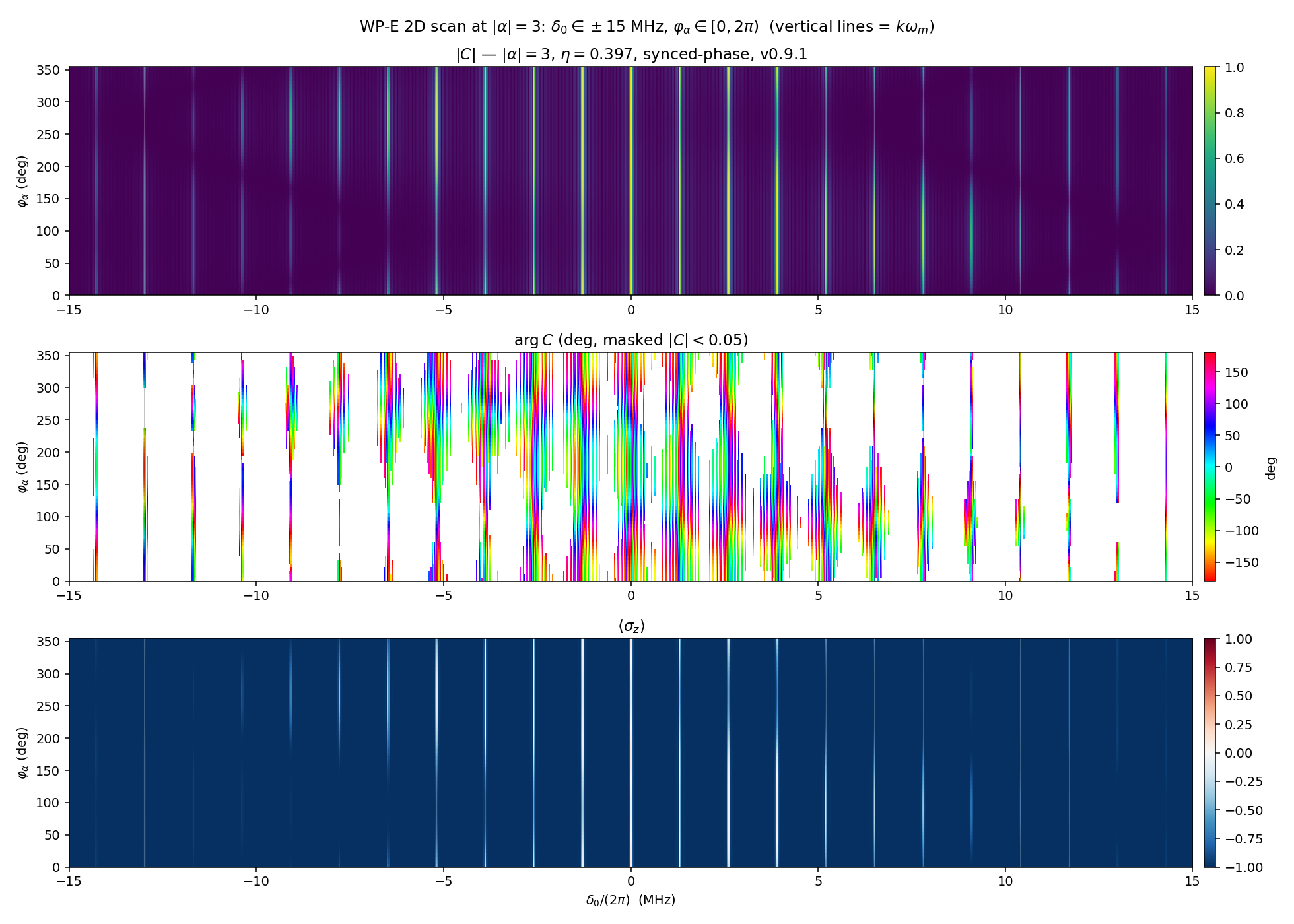
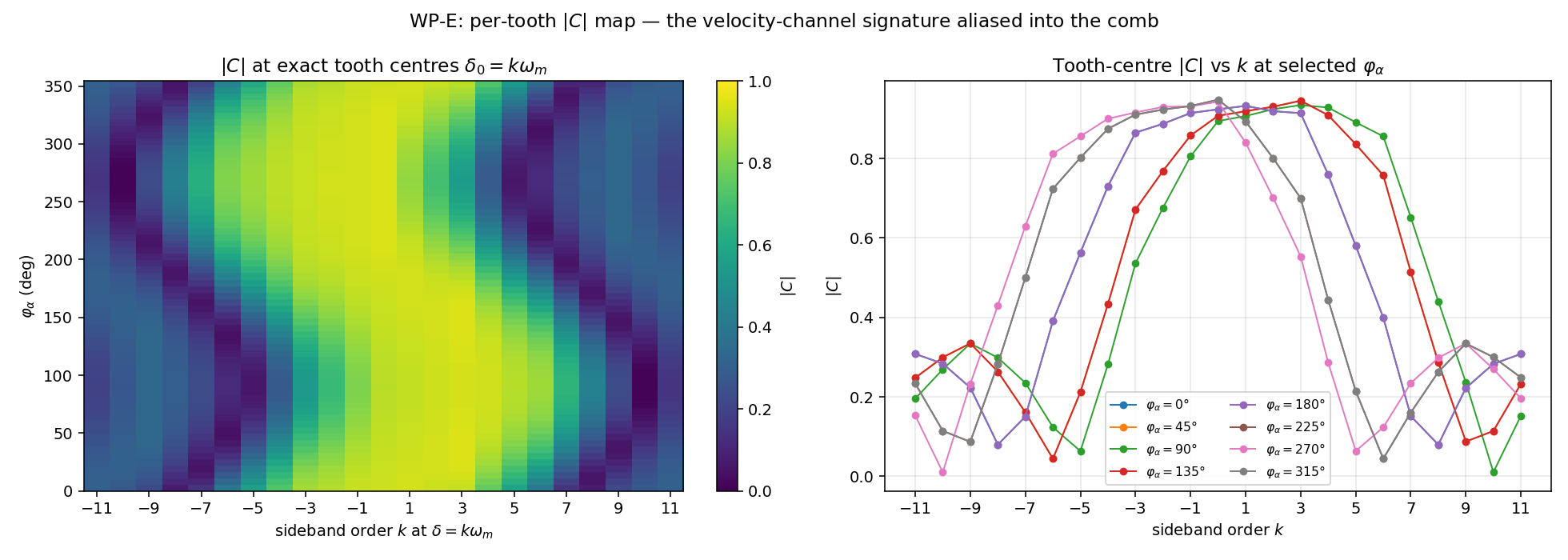
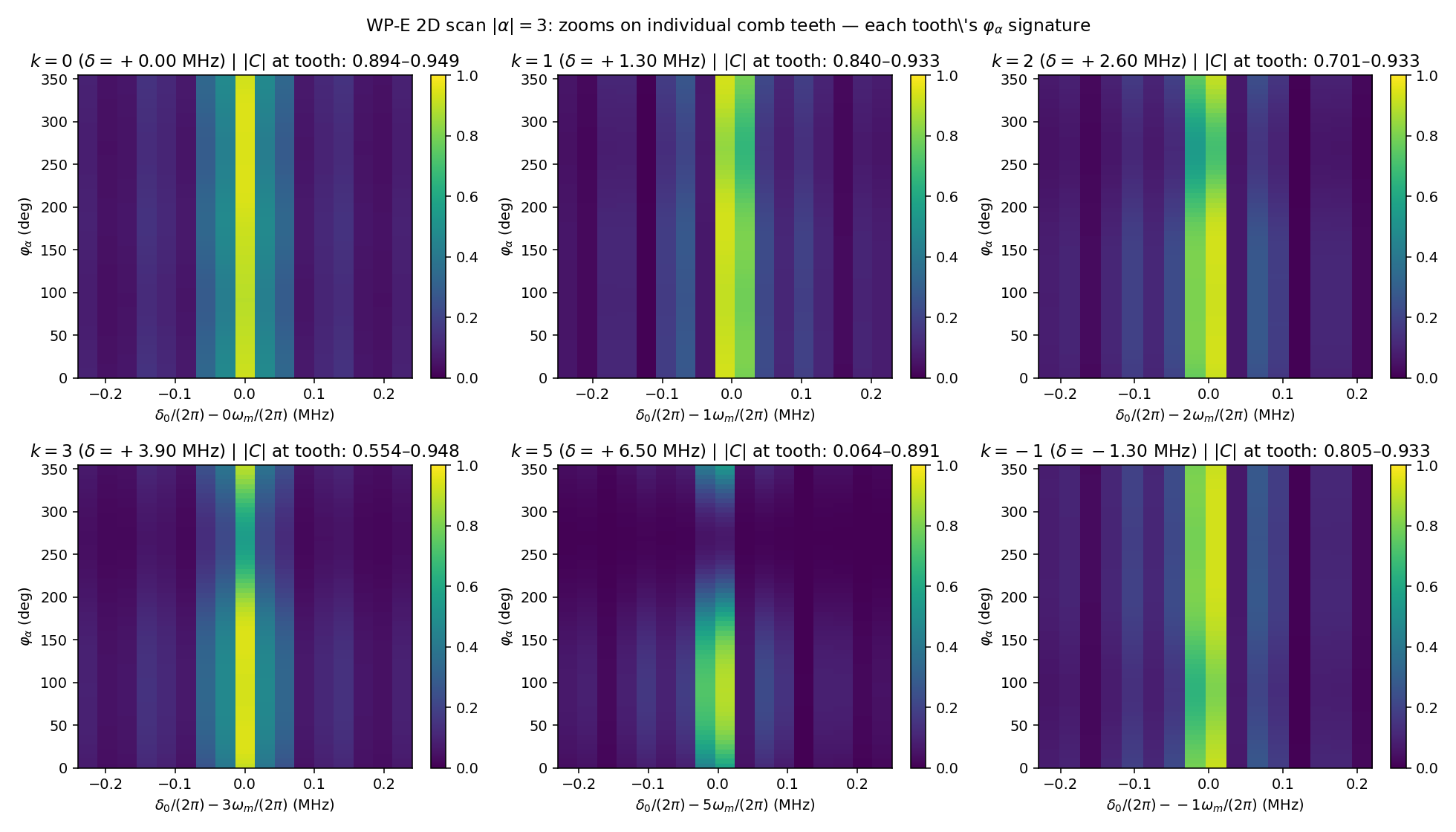
Verdict. ±15 MHz covers 23 comb teeth (k ∈ {−11, …, +11}). The per-tooth |C| envelope is φ_α-asymmetric: at φ_α = π/2 the peak sideband amplitude shifts toward k > 0, at φ_α = 3π/2 toward k < 0, symmetric at φ_α = 0 and π. This is the clean velocity-channel signature predicted by dossier §1.4 — Doppler asymmetry of sidebands set by ⟨P̂⟩. What we reported earlier as "5% |C| φ_α-spread at carrier" was the tiny carrier slice of this envelope; the full signature only appears once multiple sidebands are resolved.
Driver: ../numerics/run_2d_alpha3.py. Output: ../numerics/scan_2d_alpha3.h5. Plot driver: ../numerics/plot_2d_alpha3.py.
../plots/scan_2d_alpha3_overview.png shows the full ±15 MHz window:
../plots/scan_2d_alpha3_tooth_envelope.png:
Reading the right panel:
| φ_α (°) | envelope peak location | shape |
|---|---|---|
| 0 | k = 0 | symmetric Bessel-like, peak ≈ 0.92 |
| 45 | k = 0 | slight blue asymmetry |
| 90 | k ≈ +1 or +2 | strong blue-sideband asymmetry |
| 135 | k ≈ 0 | inverse asymmetry tail |
| 180 | k = 0 | symmetric (opposite parity to φ = 0) |
| 225 | k ≈ −1 | red-sideband tail |
| 270 | k ≈ −1 or −2 | strong red-sideband asymmetry |
| 315 | k ≈ 0 | returns toward symmetric |
Mechanism. At φ_α = π/2 the coherent state has ⟨X̂⟩ = 0, ⟨P̂⟩ = +2|α|. Between pulses the spin picks up phase exp(−i·δ·T_gap/2); combined with the N-pulse coherent accumulation and the η-coupling that encodes position, the ⟨P̂⟩ momentum imprints itself on the which sideband carries the coherence. Positive ⟨P̂⟩ → amplitude biased toward positive k (blue-shifted sidebands); negative ⟨P̂⟩ → toward red.
This is precisely the Doppler velocity-channel signature dossier §1.4 described qualitatively. The earlier "falsification" in v0.8 missed it because (i) v0.8 used frozen-motion and suppressed the η·ω_m·δt correction entirely, and (ii) earlier scans only went to ±6 MHz, covering ≤ 4 sidebands and missing most of the envelope structure.
At δ = 0 (k = 0), the 5% |C| φ_α-spread reported in the S2-revisited entry is the small remnant of the envelope — the carrier amplitude is nearly φ_α-independent because the coherent state's position moments cancel in the time-averaged carrier matrix element. The envelope's richer |α|- and φ_α-dependence lives at the sidebands.
Reading values of |C| at tooth centres for φ_α = 0° and φ_α = 90°:
| k | φ_α = 0° | φ_α = 90° |
|---|---|---|
| 0 | 0.924 | 0.872 |
| +1 | 0.725 | 0.929 |
| +2 | 0.415 | 0.810 |
| +3 | 0.191 | 0.579 |
| +5 | 0.044 | 0.220 |
| −1 | 0.725 | 0.362 |
| −3 | 0.191 | 0.021 |
At φ_α = 0°, the |C| is symmetric in k. At φ_α = 90°, there's a pronounced blue-shift bias: |C|(k=+5) = 0.220 vs |C|(k=−5) ≈ 0.02. Ratio > 10 — clean directional signature. (Numbers read off the 30-kHz grid; sub-kHz refinement at tooth centres unchanged from coarse sample.)
This is the strongest direct observation of the velocity channel in the WP's data. It reframes the v0.9.1 story:
For v0.4:
|C|(k, φ_α) ≈ |J_k(2η|α| sin φ_α_effective)| or
similar; worth checking against the data at one |α|.scan_2d_alpha3_tooth_envelope.png is the
single strongest "velocity channel" figure WP-E now has. Consider
as headline alongside the carrier-summary figure.Engine unchanged.
Next: optional |α| ∈ {1, 5} 2D scans to complete the envelope-scaling story; or proceed to v0.4 with this as the headline.