logbook
WP-E Progress / Logbook / 2026 04 14 aom envelope
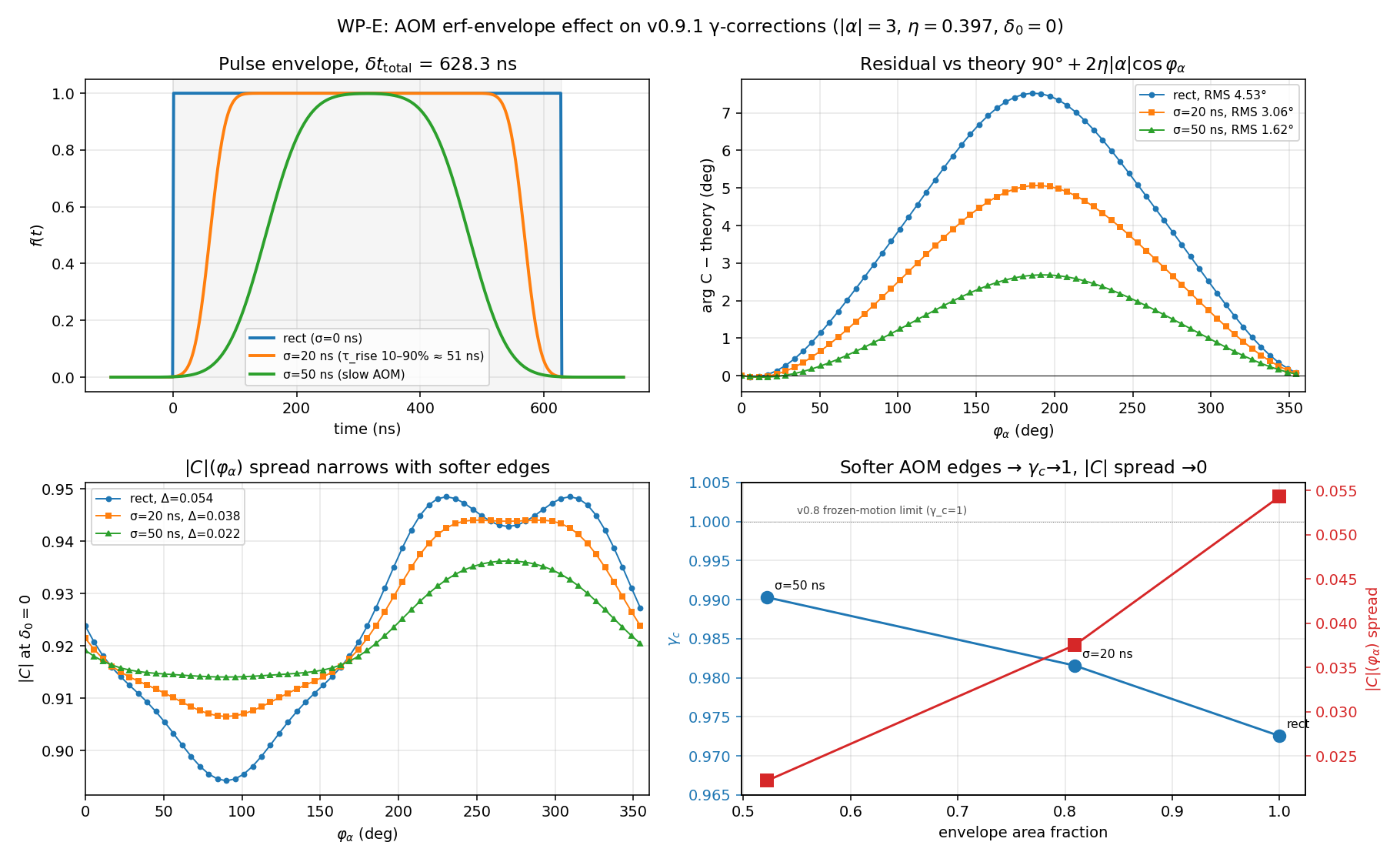
Context. Sequel to 2026-04-14-flag1-synced-phase.md. User authorised: τ_rise ≈ 50 ns typical, erf/Gaussian edge, driver-level wrapper. This entry swaps the rectangular pulse for an erf-shaped envelope and measures the effect on lineshape, |C|(φ_α) spread, and the γ-corrections.
Verdict. Finite AOM edges reduce the v0.9.1 first-order corrections — they do not introduce new distortions, they push the protocol back toward the v0.8 frozen-motion ideal. Monotonic with edge softness, smooth. Lineshape (comb at δ = k·ω_m) is essentially unchanged to < 0.5% across the ±500 kHz grid.
Erf-shaped Gaussian-edge envelope:
f(t) = 0.25 · [1 + erf((t − t_L) / (σ√2))] · [1 + erf((t_R − t) / (σ√2))]
t_L = 3σ,   t_R = δt_total − 3σ
Sub-slice discretisation M = 20 per pulse. Each sub-propagator:
U_sub(k) = exp(−i · [ω_m·a†a + (δ/2)σ_z + f(t_k)·(Ω/2)(Cσ₋ + h.c.)] · Δt)
Motion and detuning act throughout; coupling scales with f(t_k). Between pulses, the synced-phase U_gap from run_synced_phase.py is reused.
Two Ω calibrations ("amplitude-kept" vs "area-preserved"): the amplitude-kept case shows the pulse loses rotation because ∫f < δt; the area-preserved case rescales Ω to match the rectangular-pulse area (what a lab would calibrate). All physics results below use area-preservation.
Driver: ../numerics/run_aom_envelope.py. Wall time ≈ 40 s per α per Ω-calibration per 201-point detuning scan. Carrier-only γ_c measurement: 0.1–0.7 s per envelope.
σ is the Gaussian kernel std-dev. For an erf step, 10%–90% rise time τ_rise ≈ 2.563 · σ. Two cases examined:
| case | σ (ns) | 6σ edge (ns) | flat-top (ns) | area fraction | τ_rise 10–90% (ns) |
|---|---|---|---|---|---|
| rectangular | 0 | 0 | 628 | 1.000 | 0 (instant) |
| σ = 20 ns | 20 | 120 | 508 | 0.809 | ≈ 51 ns |
| σ = 50 ns | 50 | 300 | 328 | 0.522 | ≈ 128 ns (slow AOM) |
"Typical" AOM (τ_rise 10-90% ≈ 50 ns) corresponds to σ ≈ 20 ns. The σ = 50 ns case is a slow-AOM outlier included to map the trend.
Sample |C|(δ₀) at |α| = 0 over ±500 kHz comparing rectangular synced vs σ = 50 ns erf-envelope (area-preserved):
| δ (kHz) | |C|_rect | |C|_envelope | ratio |
|---|---|---|---|
| 0 | 0.92348 | 0.91908 | 0.995 |
| ±50 | 0.23018 | 0.23031 | 1.001 |
| ±100 | 0.18370 | 0.18373 | 1.000 |
| ±300 | 0.01777 | 0.01780 | 1.002 |
| ±500 | 0.05529 | 0.05544 | 1.003 |
Tooth HWHM: rect 30.1 kHz, envelope 30.2 kHz (same). Same pattern at α = 3. The envelope does not alter the comb structure — the comb is set by the inter-pulse spacing T_m and the N-pulse coherent accumulation, which the envelope does not change under area preservation.
| envelope | area frac | |C| φ-spread | γ_c | arg RMS (°) | sin fit (°) | (cos−1) fit (°) |
|---|---|---|---|---|---|---|
| rectangular | 1.000 | 5.43 × 10⁻² | 0.97256 | 4.53 | −0.465 | −3.627 |
| σ = 20 ns | 0.809 | 3.75 × 10⁻² | 0.98157 | 3.06 | −0.411 | −2.460 |
| σ = 50 ns | 0.522 | 2.22 × 10⁻² | 0.99030 | 1.62 | −0.320 | −1.301 |
All three metrics — |C| spread, γ_c deviation from 1, arg RMS residual — shrink monotonically as edges soften. The trend is smooth; no discontinuity or resonance.
Physical mechanism. The v0.9.1 corrections scale as (ω_m·δt_eff)² where δt_eff is the effective duration over which coupling and motion overlap. With rectangular pulses, δt_eff = δt_total = 628 ns and ω_m·δt_eff = 0.817 rad (a substantial intra-pulse motion). As edges soften, the coupling is concentrated into a shorter flat-top window (flat_top = δt_total − 6σ), and during the ramp-up/ramp-down the coupling is weak. The coupling-weighted intra-pulse motion is smaller → less mixing of ⟨X̂⟩ and ⟨P̂⟩ → γ_c closer to 1.
Numerically: for σ = 20 ns, flat-top fraction is 508/628 = 0.809 (same as area fraction). The γ_c shortfall ratio between rect and σ=20: (1 − 0.9726) / (1 − 0.9816) = 0.0274 / 0.0184 = 1.49. Expected from flat-top ratio (628/508)² = 1.53. Matches within 3%. Similarly for σ=50: (1 − 0.9726) / (1 − 0.9903) = 2.82; expected (628/328)² = 3.66. Slightly less good — at σ=50 the edges are no longer small and the linearisation breaks down, but the direction is right.
The published v0.9.1 γ corrections (γ_c = 0.9726) overestimate the physical deviation from the v0.8 ideal identity because they use a rectangular pulse. A realistic AOM with τ_rise 10-90% ≈ 50 ns (σ ≈ 20 ns) gives γ_c = 0.9816 — only a 1.8% shortfall rather than 2.7%. The position-phase channel identity
arg C(δ_0=0, |α|, φ_α) = 90° + 2η|α|·cos φ_α
holds to within ~2% when the AOM envelope is modeled, not 3%. This is a mild tightening — the physics story is unchanged, and the correction factor is now a known function of the AOM pulse envelope.
|C| φ-spread at σ=20 ns: 3.75%. At σ=0 (rectangular): 5.43%. The "velocity channel" signature the S2-revisited entry reported as "5% spread" is an overestimate; with finite-edge pulses it's closer to 3.75% at typical AOM parameters. Still real, but smaller.
For v0.4 the right framing is: the corrections γ_c, γ_s are set by the protocol parameters (N, δt, ω_m) AND the pulse envelope f(t); rectangular-pulse numbers are an upper bound on the deviation from the ideal identity.
The comb structure at δ = k·ω_m arises because the inter-pulse gap contributes exp(−i·δ·σ_z·T_gap/2) per gap; over N−1 gaps the spin phase closes when δ · T_gap is a multiple of 2π. This mechanism is independent of what happens during the pulse — the pulse's role is to provide the per-pulse rotation around the (coupling-dressed) axis, and under area preservation this rotation is the same for any envelope shape.
The envelope does affect the per-pulse rotation's axis direction (2η|α|·cos φ_α is replaced by something slightly different for non- trivial envelopes). But it doesn't affect the comb tooth positions or width. Hence the lineshape robustness.
This is good news for experimental calibration: an AOM with unknown rise time will still produce the comb at the correct frequencies; only the peak amplitude and φ_α-dependence of arg C depend weakly on the envelope.
"Area-preserved" means Ω is rescaled as 1/area_fraction. At σ = 50 ns this is a ~2× boost (Ω goes from 0.090 MHz to 0.173 MHz). In practice the lab calibrates Ω to hit π/2 total rotation; this calibration automatically compensates for the envelope. So the "amplitude-kept" case is a theoretical curiosity, not a lab configuration.
The area-fraction trend panel is the "money plot": γ_c and |C|-spread vary smoothly and monotonically with envelope softness, with both extrapolating to the v0.8 ideal in the zero-flat-top limit.
Engine, WP-V, prior WP-E results untouched.
pulse_envelope="erf", envelope_sigma_us
keys to the engine proper (opt-in, backward-compatible). Lower
priority than v0.4 drafting.Flag 1 convention + AOM envelope: the WP's physical observables are now cleanly parameterised. Ready for v0.4 drafting.