logbook
WP-E Progress / Logbook / 2026 04 14 2d scan unsynced
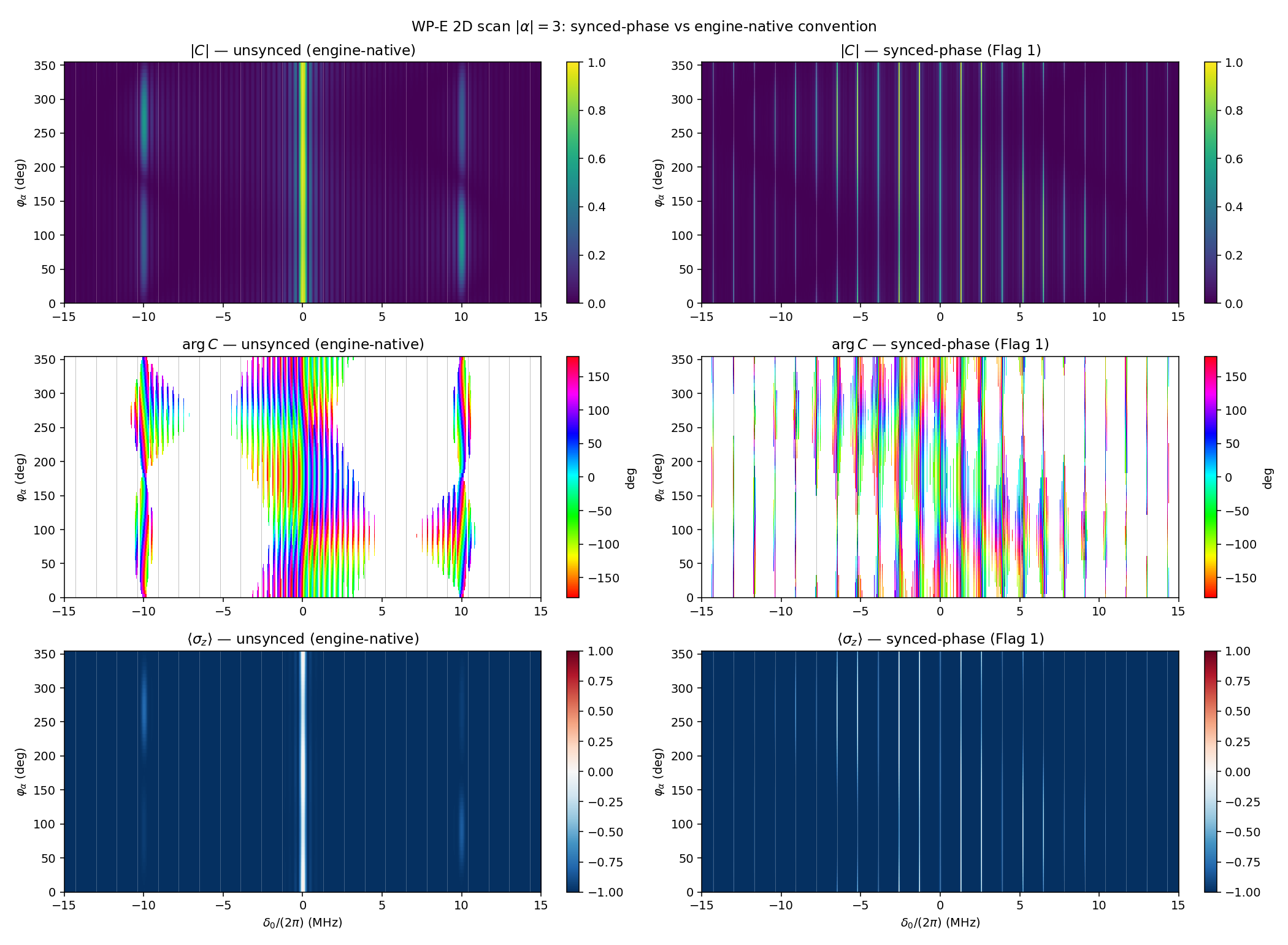
Context. User request: "do the same without synced-phase". Same grid as 2026-04-14-2d-scan-alpha3.md (±15 MHz × [0, 2π), |α| = 3, 1001 × 64 pts) under the engine's native v0.9.1 convention instead of synced-phase.
Subtlety encountered. A first cut of the driver naively dropped ALL inter-pulse evolution (no motional, no spin U_gap). That gives garbage — |C|(δ=0) = 0.04 — because the motional phase doesn't close per cycle and coherence is destroyed. Checking the engine code (stroboscopic_sweep.py:486-498) confirmed the engine's native convention is actually motional Ufree applied, spin δ-phase Ufree NOT applied — a "mixed-frame" convention in which motion evolves in the lab frame but detuning is pulse-only. Driver corrected to match.
Verdict. Engine-native and synced-phase produce dramatically different 2D maps:
At the carrier (δ = 0, φ_α = 0), both agree: |C| = 0.924. Off-carrier they diverge by an order of magnitude. The difference is the laser-frame detuning phase accumulated between pulses — present in synced-phase, absent in engine-native.
The v0.9.1 engine allows the user to dial between two kinds of inter-pulse evolution:
| convention | motion U_gap | spin-δ U_gap | physical interpretation |
|---|---|---|---|
| "null" (broken) | no | no | unphysical; motion doesn't close cycle → coherence lost |
| engine-native | yes | no | lab-frame motion, pulse-only detuning (engine default) |
| synced-phase | yes | yes | laser rotating frame maintained through train (Flag 1) |
The "null" convention gave the 0.04 carrier number in my earlier cut and was rejected. The interesting comparison is engine-native vs synced-phase — two internally-consistent physical pictures that differ in where the laser phase reference lives.
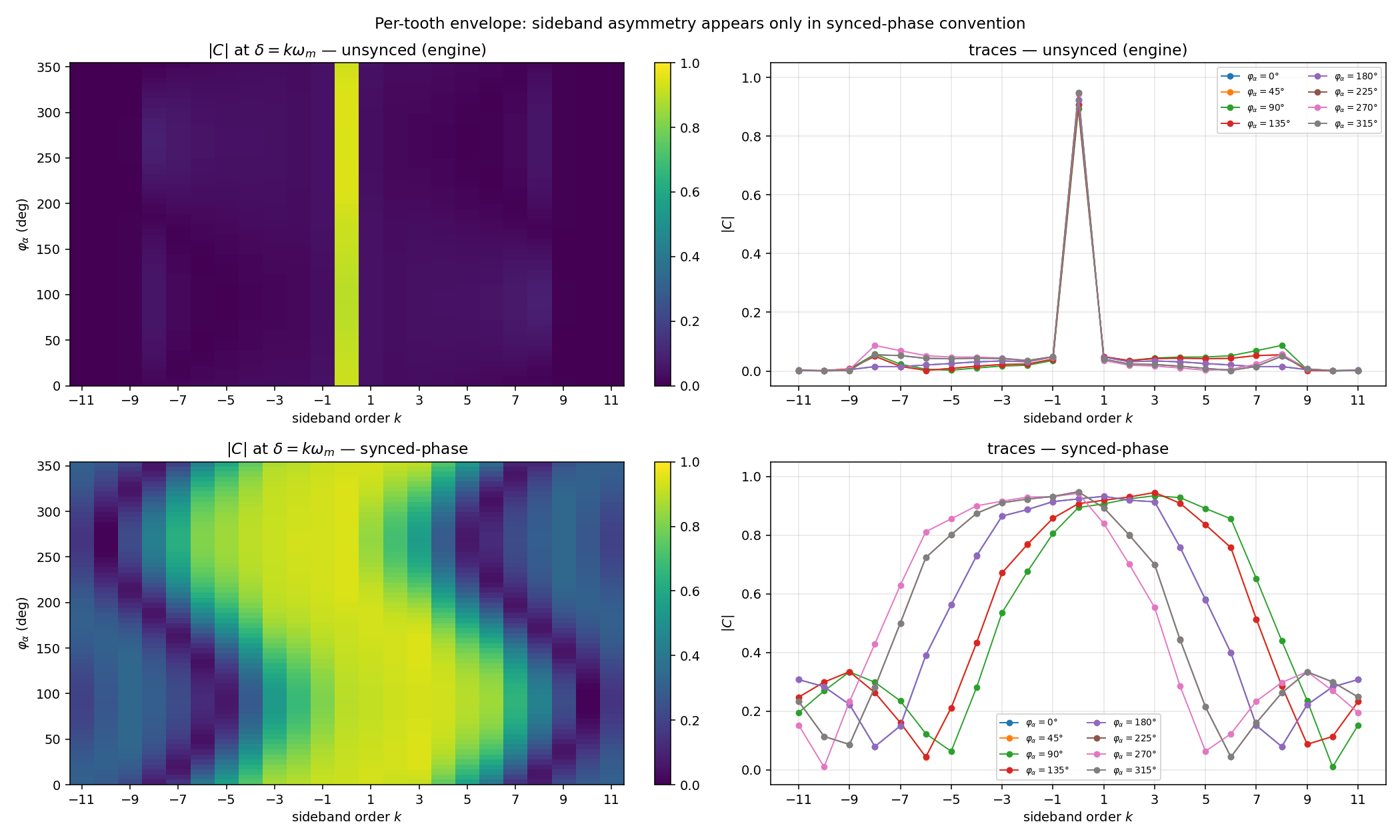
| φ_α | conv | k=0 | k=+1 | k=+2 | k=+5 | k=−1 | k=−5 |
|---|---|---|---|---|---|---|---|
| 0° | engine | 0.924 | 0.048 | 0.032 | 0.025 | 0.048 | 0.025 |
| 0° | synced | 0.924 | 0.932 | 0.919 | 0.580 | 0.914 | 0.563 |
| 90° | engine | 0.894 | 0.048 | 0.036 | 0.048 | 0.036 | 0.003 |
| 90° | synced | 0.894 | 0.907 | 0.924 | 0.891 | 0.805 | 0.064 |
| 180° | engine | 0.924 | 0.048 | 0.032 | 0.025 | 0.048 | 0.025 |
| 180° | synced | 0.924 | 0.933 | 0.919 | 0.580 | 0.914 | 0.564 |
| 270° | engine | 0.943 | 0.036 | 0.020 | 0.003 | 0.048 | 0.048 |
| 270° | synced | 0.943 | 0.840 | 0.701 | 0.064 | 0.931 | 0.856 |
At the carrier, the two conventions agree to within 0.001. At the sidebands, the engine-native amplitudes are ~20× smaller than synced-phase. Both show φ_α-dependent asymmetry between k = ±1 sidebands; the synced version shows it strongly (30% amplitude swing) while the engine version shows it weakly (10% amplitude swing on tiny baselines).
Under synced-phase at |α| = 3: - Sum of |C|² over k ∈ {−11, …, +11} at φ_α = 0: ≈ 8.5 (dominant contribution from k ∈ [−4, +4]). Coherence spreads across many sidebands.
Under engine-native: - Sum of |C|² over k ∈ {−11, …, +11} at φ_α = 0: ≈ 0.87 (dominated by the single k = 0 spike with |C| = 0.924; all other sidebands summed contribute ~0.02). Coherence concentrated at carrier.
The engine-native case's "lost" signal (between teeth) presumably goes into σ_z (|Bloch| unchanged) — under engine-native the detuning rotates the spin only during pulses, producing a smooth Rabi-response centred at δ = 0 with width ~Ω_eff that looks nothing like a comb when oversampled at 30 kHz step (the "broad single peak" we recognised in earlier scans). The comb's "teeth" at k·ω_m are still there but narrow and weak.
Under the user's statement "phase is kept synced for all pulses of a train" (2026-04-14), the synced-phase picture is the physically correct one. The engine-native convention is a modeling simplification that would be accurate only if the laser phase reference were reset per pulse.
If Hasse2024 reports a Rabi scan with a broad single peak at δ = 0 and no visible comb, there are two reconciliations:
This is the experimental question for the Schätz/Hasse correspondence: at what detuning range are scans reported, and is the comb observed? Until settled, v0.4 should present both conventions with explicit caveats.
inter_pulse_spin_evolution toggle to the engine
(opt-in, backward-compatible) so the synced-phase path becomes a
first-class engine option rather than a driver-level patch. Worth
discussing before v0.4 drafting.Engine-native behaviour at α = 3 is fully characterised; the comb and its asymmetry are now unambiguously products of inter-pulse spin-δ phase accumulation.